
You’ve spent your career
making decisions that can’t
afford to be wrong.
You read the data yourself. You challenge the assumptions. You don’t sign off on something because someone handed you a summary and told you it was fine. That’s how I treat every deal that touches your capital.
I’ve been a data analyst for nearly thirty years. Not the kind who runs a report and forwards it — the kind who sits with the numbers until they tell me something nobody asked them to say.
That started in healthcare. Decades of mergers, acquisitions, and turnarounds where I learned that the story someone wants you to see is never the whole story. The real story lives in the details they glossed over, the assumptions they didn’t explain, and the questions they hoped you wouldn’t think to ask.
When I started investing in real estate, I brought that same instinct with me. Not because I read a book about due diligence — because I genuinely need the true picture landscape of every acquisition.
Here’s what typically happens with a deal. A broker sends an offering memorandum. The sponsor plugs those numbers into their model. Maybe they adjust rent growth a point or two. And then they put it in a deck and show it to you.
That’s not underwriting. That’s repeating.
The assumptions in that deck? Often hypothetical — tuned to make the returns look like what investors want to see, not what the market is actually doing. The rent comps? Pulled from the broker’s package, not independently verified. The competitive landscape? Rarely mentioned, because it complicates the narrative.
Nobody pulled the county planning records to see what’s been permitted a mile away. Nobody mapped the competition to find out who’s offering two months free to fill units. Nobody asked why occupancy spiked in Q3 — was it real demand, or a concession play that’s about to unwind?
Those are the questions I ask. Every deal. Before anything else happens.
When a deal reaches my desk, it goes through two passes. The first is a preliminary underwriting — I model it myself, from the raw financials, to see if the basic economics hold. Most deals die here.
The ones that survive get the second pass. That’s where I become a data analyst again — and where I go far beyond what most sponsors would ever think to look at.
This is the work that happens before a property ever makes it to a pitch. Every item on this list is reviewed manually — not generated by software, not pulled from a template.
Market & Competitive Intelligence
- City planning and zoning records
- County development and permitting reports
- Submarket demographic and population trends
- Employment and wage growth data
- New construction pipeline and delivery timelines
- Full competitive property mapping
- Competitor rent rates and concession strategies
- School district quality and proximity analysis
- Infrastructure and transportation development
- Local legislative and regulatory landscape
Financial & Operational Analysis
- Independent rent comp verification
- Historical revenue and expense trending
- Occupancy pattern analysis and seasonal variance
- Real-scenario stress testing — not best-case projections
- Insurance and property tax trajectory modeling
- Capital expenditure assessment and deferred maintenance review
- Utility cost analysis and billing structure
- Management fee and operational cost benchmarking
- Debt structure evaluation and rate sensitivity
- Exit strategy modeling under multiple market conditions
I stress-test against real scenarios, not hypothetical assumptions designed to make the returns look good on a slide. What happens when occupancy drops. When insurance spikes. When the rate environment shifts. If the deal only works in a best case, it doesn’t work.
And I do all of this personally. Manually reviewed, manually touched, manually questioned — because thirty years of sitting with data has taught me that the things you catch are the things a system would never think to look for.
I do use AI in my preliminary analysis. It increases the speed and efficiency of finding data and information that manual searches alone might never surface. But I’ve seen too many sponsors lean on AI as if it’s the answer. It’s not. It’s a tool — and like any tool, it’s only as good as the person verifying what it finds.
Every claim, every finding that AI produces gets validated by me personally. I don’t take a result at face value because a system generated it. I confirm it — because accuracy isn’t a setting you turn on. It’s a discipline you practice.
But here’s what AI can do that changes everything: it finds what nobody thought to look for.
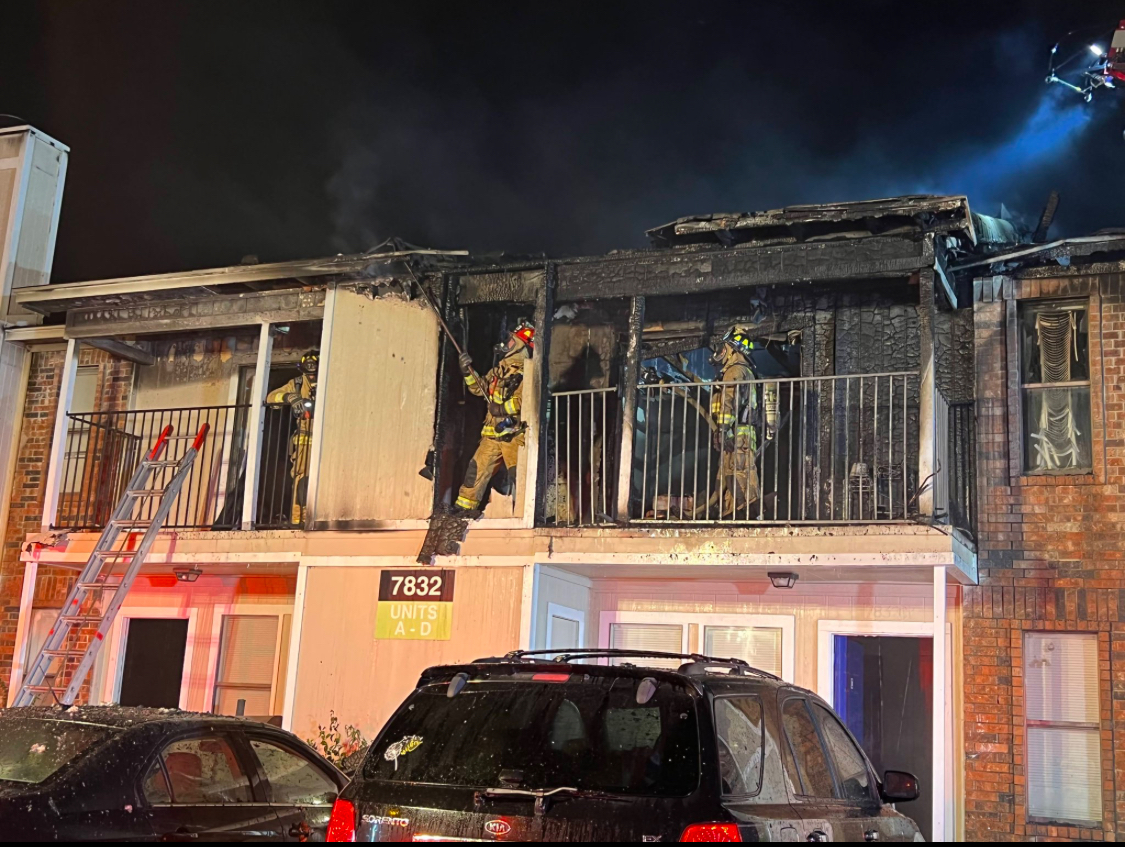
This property image was surfaced by AI during due diligence — uncovering critical information that was never disclosed by the broker.
We were deep into analysis on a property we were genuinely excited about. The financials were strong. The market was right. And then AI surfaced something buried in an old Facebook post — pictures and videos of one of the buildings engulfed in flames.
That fire was not disclosed by the broker. It was not in the offering memorandum. It was not a conversation during the property walkthrough. Without AI discovery, we may never have known — and without the discipline to verify what AI surfaces, we wouldn’t have known what to do with it.
And for anyone thinking, “Well, you would just ask for a loss run report” — we did. The loss run came back showing zero claims. All the way back to before and after the fire that supposedly happened. No record. No explanation for why a building fire never appeared on an insurance claim.
The only reasonable conclusion: it was paid for out of pocket so it would never show up on a loss run. That’s a level of concealment that traditional due diligence — even the steps most people consider thorough — would never catch.
That’s the difference between using technology and depending on it. And it’s the difference between checking the boxes and actually protecting your investors’ capital.
My analysis doesn’t stop with me.
After I’ve completed my full review, a team member independently runs the same analysis. Same data. Same questions. Fresh eyes. Then we sit down together, compare what we found, and poke holes in every assumption — including our own.
If the broker brought us a number, we challenge it. If our own model produced a number that feels generous, we challenge that too. The goal is not to confirm what we hope is true. The goal is to find what breaks — and to find it before your capital is on the line, not after.
This is what stewardship looks like. Not a promise on a pitch deck — a visible, repeatable discipline that our investors can see in every deal we bring them. Transparency isn’t a value we talk about. It’s a practice we show.
Most of the deals I look at
never reach my investors.
The broker’s one-pager looked strong. The returns modeled well at first glance. But somewhere in the county records, the competitive landscape, the expense trending, or the assumptions underneath the projections — the story fell apart.
That’s not a limitation. That’s the entire point. I would rather pass on a hundred deals that looked good than bring my investors one that wasn’t.
Behind the Work
“What I actually look at before your capital touches a property.”
Video coming soon
I don’t underwrite the broker’s story — I verify every number independently and investigate the market beyond the deal, because I’ve spent thirty years finding what others miss in the details.
“I treat your money as if it’s my own.”
— Melissa Hawkins
Request Invitation